

How much is my house worth in Québec? Free, instant estimate
Find out how much your house is worth in Québec. Free, instant estimate based on municipal data, real transactions, and Doormath-exclusive data.
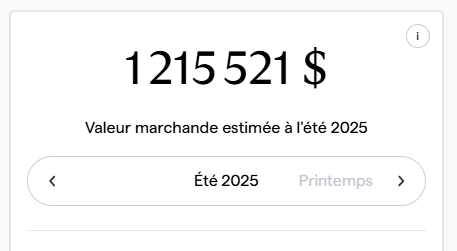
- Estimate in under 30 seconds
- No sign-up required for a first estimate
Why Doormath is more precise than a neighborhood average
A neighborhood average can be a rough benchmark, but it often misses what truly moves price: street-level differences and the separation between location value and property features.
- Average ≠ market reality.
- Street-level effects matter (traffic, noise, views, proximity).
- We separate location value from property features to avoid mixing causes.
How Doormath estimates home value in Québec
The estimate is built from official sources and real transactions, then refined with Doormath-exclusive layers and validated user corrections.
- Municipal data (assessment roll)
- Real closed transactions (sold prices)
- Exclusive Doormath data:
- Detailed renovation levels
- Waterfront / water access
- High-traffic streets
- Intra-neighborhood micro-location
- User contributions and corrections
Real estate micro-location: why one street can be worth more than another
Micro-location is the street-level component of value. Within the same area, nearby blocks can trade at different price levels even before you consider renovations or size.
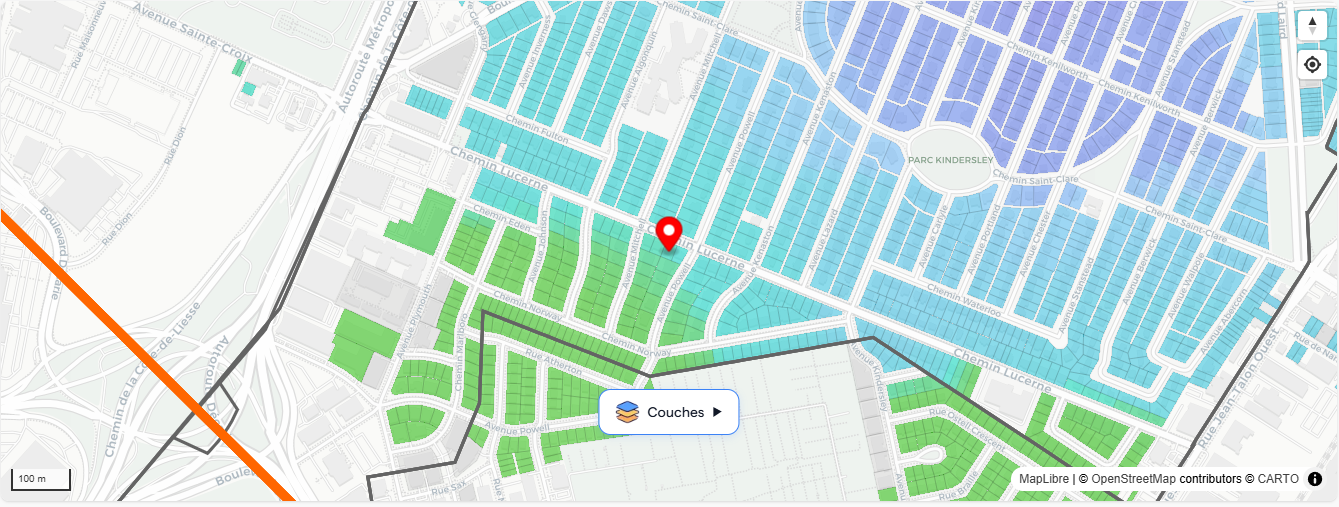
Example screenshot: the map highlights micro-location differences across nearby blocks.
Proof lives on the interactive property value map.
Market value vs municipal assessment in Québec: what’s the difference?
In Québec, the municipal assessment (évaluation municipale) is mainly an administrative value used for taxation. It’s updated on a schedule and can lag the real market by months or years, especially during rapid changes in interest rates or buyer demand. Market value, on the other hand, is what a typical buyer would pay today under normal conditions.
That’s why two homes with similar municipal assessments can sell for very different prices. Micro-location, layout, and condition can move the price a lot—and the market itself can shift over time.
It takes more than a few comps to appraise a property
Why Centris prices aren’t enough to estimate a home: Centris is a listing platform. Asking prices are not sold prices, and listings can be optimized for marketing (photos, staging, timing).
Even if you find “similar” homes, you still need to adjust for (1) time (a sale from last year isn’t today’s market), (2) each characteristic (what is a garage worth here, at this price point?), and (3) size (price-per-sqft is not linear—300→400 sq ft doesn’t behave like 2000→2100 sq ft).
Doormath bakes those adjustments into the estimate. Instead of forcing you to hand-pick a few examples, you enter the right facts (micro-location, size/layout, and a detailed renovation level) and the price updates live.
Place a home within its market sector
An estimate alone is incomplete without market context. Sector-level dispersion helps you interpret what’s typical vs exceptional for similar homes.
Add context with Québec real estate sector statistics.
What data Doormath relies on
We try to be explicit about inputs so you can interpret the estimate appropriately.
- Official municipal data
- Closed transactions
- Exclusive Doormath data
- Validated contributions
When you need a professional appraisal
An online calculator is great for planning, negotiations, and getting a directional estimate. But some situations require a certified, report-based appraisal (for example, certain financing, legal contexts, or complex properties). If you’re unsure, it’s worth confirming with your lender or notary.
- Refinancing or specific lender requirements
- Estate / divorce / legal proceedings
- Unique properties (very atypical, rural, waterfront)
We have data across Québec, but appraisals are available in selected sectors. See Doormath’s currently covered sectors.
How long does a Doormath estimate take?
Typically under 30 seconds for a first estimate. The more accurate the inputs (living area, renovations, etc.), the more consistent the estimate.
Do I need an account to estimate my home?
No. You can get a first estimate without signing up. You can then adjust details to improve accuracy.
Which inputs impact value the most?
Micro-location, living area and layout, condition/renovations, and recent comparable sold transactions.
Why does market value differ from municipal assessment?
Municipal assessment is mainly for taxation and updates on a schedule. Market value reflects today’s market and can move faster.
Is this available everywhere in Québec?
Doormath has Québec-wide data, but appraisals are available in selected sectors. Check the coverage page to confirm your sector.