

Home valuation (market value)
Understand your Québec market value. Adjust key characteristics and see the price update live. Free, instant estimate based on real data + AI.
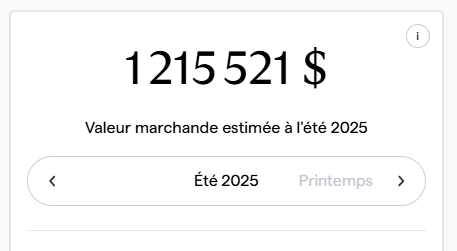
- Estimate in under 30 seconds
- No sign-up required for a first estimate
What “home valuation” means in Québec
In everyday language, ‘home valuation’ can mean three different things: (1) municipal assessment used for taxes, (2) a market value estimate used for selling or planning, and (3) a certified appraisal report required by a lender or in a legal context. If you searched ‘évaluation maison’, you likely want (2): market value—what your home could sell for today.
A good market value estimate should react to reality: the same “sector” can contain micro-markets where one street is worth more than the next. The key is separating location effects from property features (size, layout, renovations) instead of mixing them.
Interactive calculator: the price updates live
Doormath is designed to be transparent: when you change real inputs (living area, layout, renovation level), the estimate updates immediately. It’s not a single “black box” number—it’s a model you can correct.
Why this matters: many valuation tools “hide” model errors inside a vague renovation category. Doormath uses a detailed 20-step renovation level, so the model can attribute fine differences inside a sector to micro-location (street-by-street), not to guesswork about condition.
Micro-location you can see
We visualize location value on an interactive map. The idea is simple: if two otherwise similar homes differ in price consistently, the map should reflect that difference at the block level.
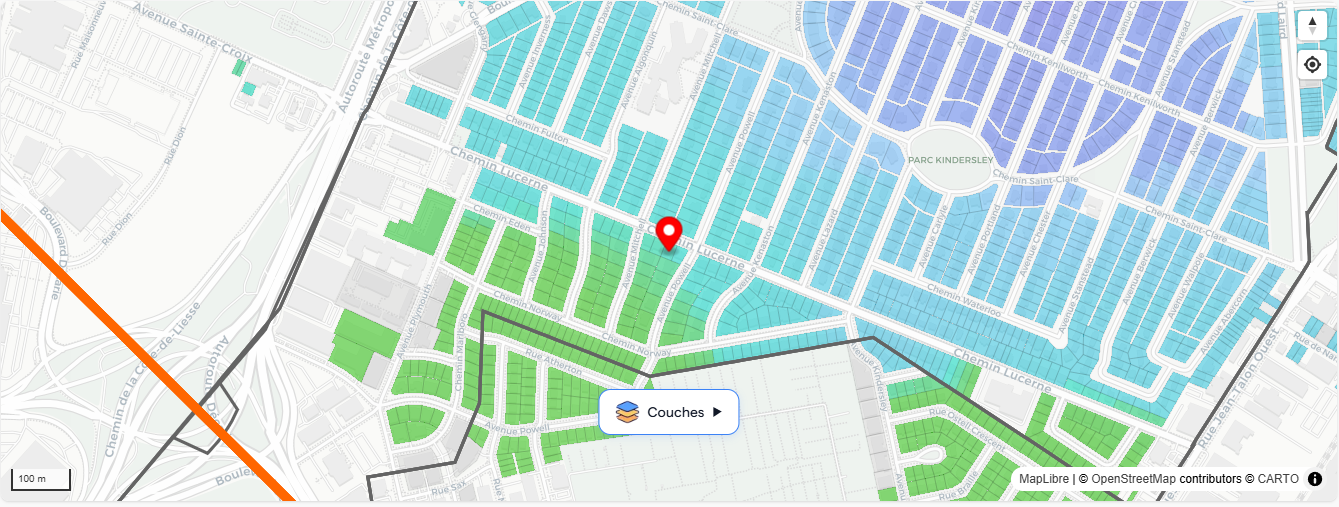
Example screenshot: nearby blocks can carry different location value.
What drives value the most (practical)
In practice, you can think of the price as three simple layers:
- Location value (micro-location): street, noise, transit, schools, parks, views.
- Home features: living area and layout, lot/building attributes, year built.
- Condition/renovations: captured with a detailed 20-step renovation level (not a rough bucket).
When these inputs are correct, the estimate becomes reliable—because the model can put the “nuance” in the right place. That’s also why we make it easy to adjust the data: accuracy is a collaboration between the model and your inputs.
It takes more than a couple comps
A common shortcut is to pick a few “similar” sales and call it a day. The problem: comps only work after adjustments, because no two homes are identical.
- Adjust for time (market conditions change).
- Adjust for features (garage, basement, views—value depends on the area and the price range).
- Adjust for size (price-per-sqft is not linear).
Doormath is built to do these adjustments in the background. You focus on entering the right data (especially renovation level), and the price updates live.
Municipal assessment: how to use it (and how not to)
Municipal assessment is useful as a reference point, but it shouldn’t be treated as a pricing tool. It can be outdated, and it often won’t capture a renovation, a high-end finish level, or an exceptional view. Use it as one signal among others—never as the only anchor.
Does “home valuation” mean municipal assessment?
Not necessarily. Most people mean market value (likely sale price). Municipal assessment is mainly for taxation and can lag the market.
What factors drive value the most?
Micro-location, living area and layout, condition/renovations, year built, and recent comparable sales.
How often can market value change?
It can change quickly with interest rates, local demand, and recent comparable sales—so static estimates can become outdated fast.
Can I use an online estimate for refinancing?
For planning, yes. But lenders may require a certified appraisal report. Always confirm requirements with your institution.
Does Doormath replace a certified appraiser?
No. Doormath provides a market value estimate to guide decisions. It is not the opinion of a real-estate broker. A certified report is required in some contexts.